The numbers, 429,603 acres, 709 structures destroyed, thousands evacuated, only begin to capture the scale of loss.
On a scorching July afternoon in 2024, Upper Bidwell Park east of Chico, California, offered its usual summer escape. Temperatures soared past 100 degrees under a National Weather Service red-flag warning. Low humidity, strong winds, and bone-dry vegetation created perfect conditions for disaster. Swimmers gathered at popular spots like Bear Hole and Alligator Hole along Big Chico Creek, seeking relief in the water amid the oak-studded hills and brushy ravines.
Among them was Ronnie Dean Stout II, a 42-year-old Chico resident with a long criminal history. Witnesses later described him as heavily intoxicated. He had purchased malt liquor that morning and spent time at Bear Hole, where he harassed bathers with insulting comments. Then he climbed into his mother’s 2007 Toyota Yaris and drove west along the gravel Upper Park Road toward town.
His driving was reckless. Witnesses reported speeds of 30 to 50 miles per hour on the rough surface. Near Alligator Hole, the small car slid off the road and high-centered on a dirt berm or mound of earth roughly 60 feet above a steep, brush-filled gully. Dry grass and vegetation surrounded the stuck vehicle.
Stout tried to free it. He shifted repeatedly between forward and reverse, revving the engine hard. The spinning tires ground against the parched grass and brush. On a day already primed for fire, heat and friction ignited the vegetation underneath. Flames quickly spread to the car itself.
What happened next became the decisive act. A witness, Elizabeth Fox, testified that she saw Stout get out of the flaming vehicle, stand briefly watching the fire, then push the burning car over the edge of the berm. The Yaris rolled down the 60-foot embankment into the ravine. Upon impact it erupted more fully, sending flames racing through the dry brush and grass at the bottom. Stout, according to accounts, then calmly blended into the crowd of people fleeing the area as smoke and fire began to rise.
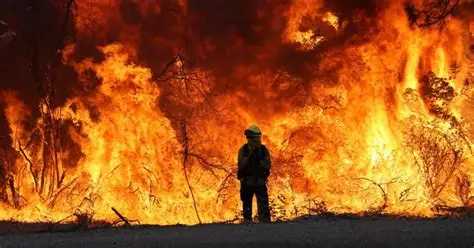
The time was approximately 2:30 to 3:00 p.m. on July 24, 2024. Within minutes the fire was growing. By 5:00 p.m. it had reached 500 acres. An hour later it was 1,000 acres, then 1,500. Strong south winds and extreme heat turned the spark into a rapidly advancing wildfire that would become known as the Park Fire, California’s fourth-largest on record and the largest of the 2024 season.
The blaze raced northeast through steep canyons and ridgelines. By the next morning it had exploded across tens of thousands of acres. Evacuation orders went out for communities in its path: northeastern Chico, Forest Ranch, and especially Cohasset, a small foothill town of a few hundred residents accessible primarily by a single winding road. Residents of Cohasset found themselves trapped as flames overran the main exit. In a harrowing escape, many were guided by workers from a local timber company down narrow logging roads to safety on Highway 32. One resident captured video of a towering wall of fire while praying aloud as she fled.
Cohasset took a direct hit. Much of the community was reduced to ash and twisted metal. Homes that had stood for decades, some occupied by retirees who had sought quiet mountain living, were gone. Similar destruction struck parts of Forest Ranch. Across the fire’s footprint, which eventually stretched into Butte, Tehama, Plumas, and Shasta counties, the human toll mounted. More than 4,000 people were forced to evacuate at various points; some estimates placed the number higher. Families lost everything: houses, vehicles, personal belongings, and the sense of security that comes with a home in the woods.
Final damage assessments painted a stark picture. The Park Fire destroyed 709 structures and damaged 54 others. Of those destroyed, 427 were single-family residences. Seven commercial properties and 275 other minor structures, sheds, outbuildings, and the like, also burned. In Cohasset and surrounding unincorporated areas of Butte County alone, hundreds of homes vanished. The Big Chico Creek Ecological Reserve, an 7,800-acre educational property belonging to Chico State University, lost the majority of its land and several buildings, including a historic barn. A 1936 fire lookout at McCarthy Point was destroyed. Electrical infrastructure suffered heavily: hundreds of power poles, transformers, and line segments were lost, particularly around Cohasset and Forest Ranch.
The fire burned for more than two months. It ultimately consumed 429,603 acres, 671 square miles, before full containment was declared on September 26, 2024. Firefighting costs reached hundreds of millions of dollars, with estimates ranging from $275 million to $351 million. At the peak of the response, thousands of firefighters and support personnel worked the lines. A handful suffered heat-related injuries, but remarkably, no civilian fatalities were reported.
The landscape left behind was transformed. Blackened hillsides, scorched forests, and denuded canyons stretched for miles. In Cohasset, survivors returned to a community that felt unrecognizable. Cleanup dragged on for a year and beyond. Debris removal, hazardous tree cutting, and the constant rumble of heavy trucks became the new normal. Some residents described the once-quiet roads as feeling like freeways. Rebuilding was slow; a year later only a handful of permits had been issued. For many, insurance complications and the sheer scale of loss made recovery uncertain. Artists who had long used the area for retreats mourned the destruction of a natural muse. Families who had lived there for decades faced displacement, temporary housing, and the emotional weight of survivor’s guilt.
Stout was arrested in the early hours of July 25, 2024, at a mobile home park in Chico. Investigators had identified him through witness statements and photographs that circulated online. His blood-alcohol level remained elevated hours after the ignition. He told authorities the fire was an accident, that the car had caught fire while stuck, and that he fled because he was frightened. He denied pushing the vehicle into the ravine. Prosecutors and the court saw it differently.
Two years later, on July 24, 2026, the exact anniversary of the fire, Judge Kristen Lucena of Butte County Superior Court found him guilty of willful and malicious arson after a bench trial. The conviction included enhancements for the destruction of residential structures and for prior serious felony convictions under California’s three-strikes law. Stout, by then 44, faced a potential sentence of 25 years to life. Sentencing was scheduled for October 2026. Throughout the proceedings, the prosecution emphasized a series of intentional acts under extreme fire conditions. The defense argued accident and insufficient proof of intent. The judge concluded the evidence, particularly the act of pushing the burning car, established the required willful intent.
The Park Fire stands as a stark illustration of how a single sequence of decisions on a dangerous day can cascade into regional catastrophe. What began with intoxication, reckless driving, and the deliberate movement of a burning vehicle into dry brush became a multi-county disaster that erased homes, altered landscapes, displaced thousands, and cost hundreds of millions of dollars to suppress. Communities like Cohasset continue the long work of recovery, while the legal consequences for the man found responsible unfold in the courts. The numbers, 429,603 acres, 709 structures destroyed, thousands evacuated, only begin to capture the scale of loss. Behind each figure are individual stories of flight, survival, and the slow effort to rebuild what fire took away.