




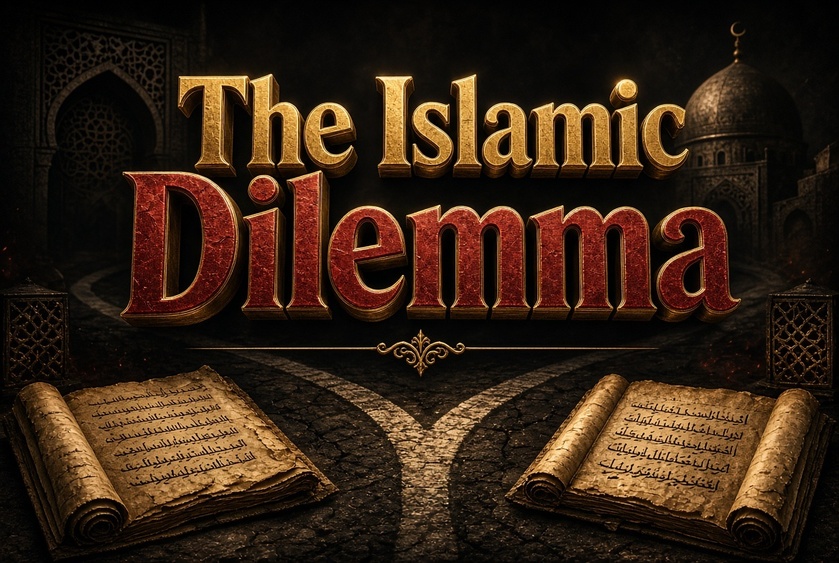
The Islamic Dilemma
Every Muslim who learns the Islamic Dilemma and understands the argument
becomes an apostate, knowingly or unknowingly. This is not a prediction or a
provocation. It is the direct result of what the Quran itself affirms and what it
simultaneously contradicts. There is no third option that preserves both the Quran’s
claims and the Muslim’s commitment to them.
An apostate is not simply someone who never believed. The word comes from the
ancient Greek apostasia, meaning defection, rebellion, desertion, or the
abandonment of a previous allegiance. An apostate is a person who has renounced
or rejected a religion, faith, or set of fundamental beliefs that he or she once
professed. Apostasy is the act or condition of that abandonment. It can be deliberate
and open, or it can occur through the quiet rejection of core claims while the person
continues to use the name of the religion. In either case the previous commitment
has been left behind.
The Islamic Dilemma is simple to state.
The Quran affirms the inspiration, preservation, and authority of the Jewish and Christian scriptures. At the same time, the Quran contradicts those same scriptures on basic doctrines. This creates an
unavoidable fork. Either Christians and Jews possess the inspired, preserved,
authoritative Word of God, or they do not.
There is no middle ground. If they do possess the inspired, preserved, authoritative Word of God, then Islam is false, because Islam contradicts that Word on fundamental points. If they do not
possess the inspired, preserved, authoritative Word of God, then Islam is again false,
because the Quran affirms that those scriptures are exactly that. One path makes
Islam false by contradiction. The other path makes Islam false by self-contradiction.
Either way, Islam is false. The dilemma is not solved by insisting that the earlier
scriptures were later corrupted; the Quran’s own affirmations do not leave that
escape open in the way many assume.
The textual basis for the affirmation is not obscure. Surah 3:84 declares: “We believe
in Allah and in what has been revealed to us and in what was revealed to Abraham
and Ishmael and Isaac and Jacob and the tribes and in what was given to Moses and
Jesus and the prophets from their Lord. We do not make any distinction between any
of them and to him do we submit.” Muslims are required to believe not only in the
Quran but in all the revelations given to all of God’s prophets and messengers. They
are explicitly forbidden from making any distinction among those revelations. The
Quran presents this as a matter of straightforward submission, not selective
acceptance.
This is decisive. The dilemma does not rest on secondary or disputed passages. It
rests on the Quran’s clear requirement that the previous scriptures be received
without distinction. Once that requirement is granted, the contradiction with the
content of those scriptures cannot be wished away. The Muslim is then left with only
two responses: accept that the contradiction falsifies Islam, or reinterpret and
effectively reject what the Quran has stated. The first response is open apostasy. The
second response is apostasy as well, even if the person continues to call himself a
Muslim. To reject or empty the force of the Quran’s own affirmations while retaining
the label is still to abandon the commitment the text demands.
The Quran removes the usual refuge of complexity. It claims to be perfectly clear.
Allah, according to the Quran, means exactly what He says. There is no hidden layer
that permits Muslims to affirm the previous scriptures in principle while denying
their actual content in practice. When the text says believers make no distinction
among the revelations, the natural reading is that the revelations stand together. Any
system that must treat the earlier revelations as untrustworthy on core doctrines has
already introduced the distinction the Quran forbids.
Explain the dilemma to a Muslim and the outcome follows. He will either recognize
that Islam cannot survive the contradiction and leave the religion, or he will be forced
to reinterpret and set aside what Muhammad and Allah have clearly said. In the first
case he becomes an apostate knowingly. In the second case he becomes an apostate
without acknowledging it, because he has already rejected a foundational claim of
the faith he still names.
Either path ends in the same place: the original allegiance has been abandoned.
The Islamic Dilemma is therefore not an external attack. It is the internal
consequence of taking the Quran’s affirmations at face value while noticing that
those affirmations cannot be reconciled with the Quran’s own teachings. The logic
is binary and closed. If the Jewish and Christian scriptures are what the Quran says
they are, Islam is false.
If they are not what the Quran says they are, Islam is false.
There is no remaining option in which Islam remains true. That is the dilemma, and
that is why understanding it leaves no stable ground inside the religion.